Thursday, January 28, 2016

A Rock Expert in Action, Better Known as a Geologist

Sometimes good things happen that we have nothing to do with and you can’t but feel lucky, humbled, and grateful. Last Friday I was emailed by geologist Josh Goodwin who was already scheduled to speak to the second graders about their content in earth science and was offering to spend some time with the fourth graders as well. I eagerly accepted and then went about making sure we would be able to, schedule and facility-wise. By weekend’s end everything was set and I excitedly began to await what would come.
Monday morning came and my enthusiasm didn't wane. Around 10am we entered the library where Mr. Goodwin was waiting. Around six tables were arrayed with various rock and mineral samples as well as accompanying signs, captions, and labels.  The kids sat with a palpable sense of controlled interest.
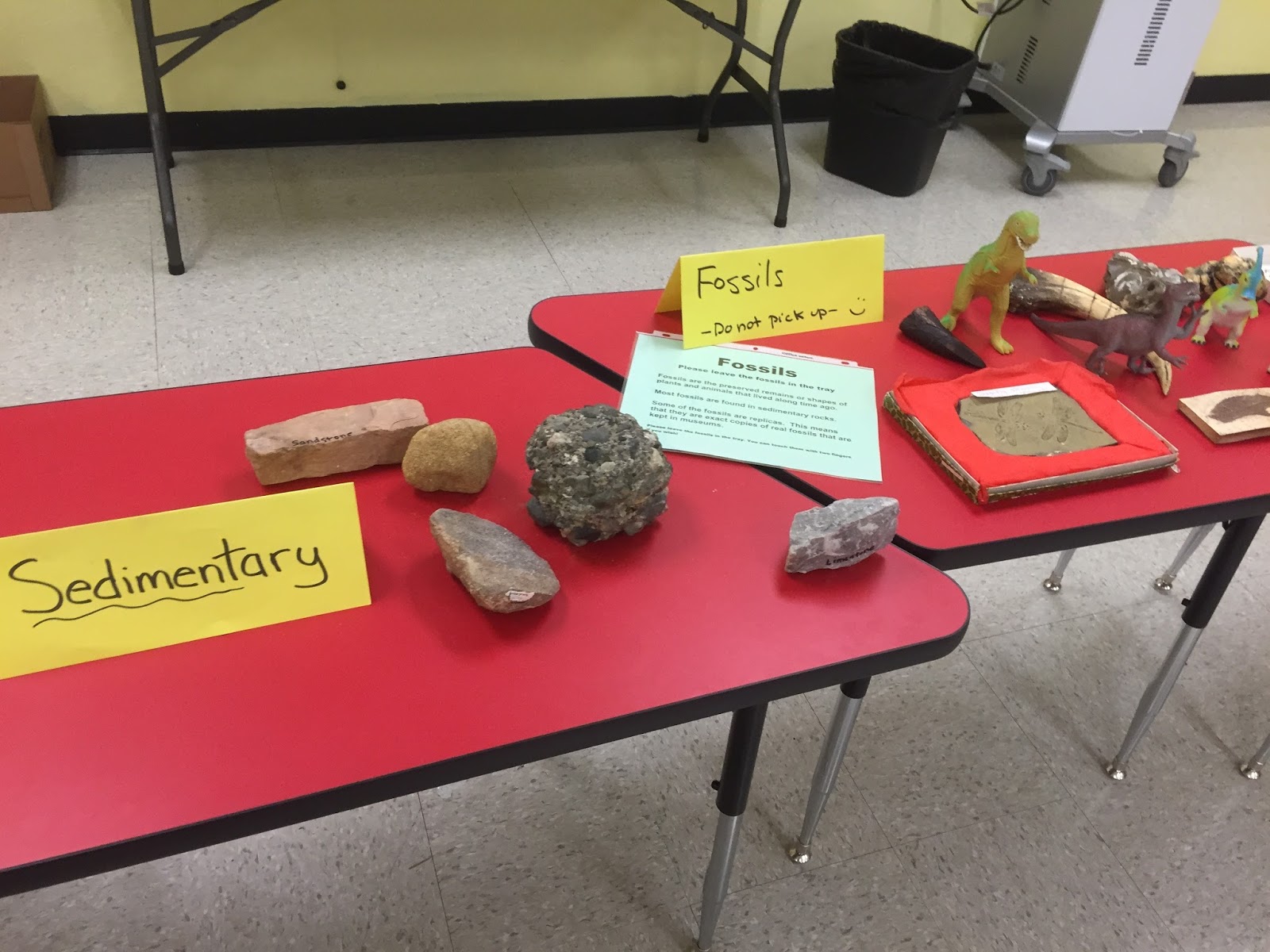
Mr. Goodwin began his presentation giving background on what a geologist does, what he specifically has done, and gauging student’s prior knowledge of the subject intermittently. Then he began going over each of the tables, both reviewing the basics that students should already have been exposed to, and elaborating on models and samples of rocks. We got the chance to see igneous rocks such as basalt, pumice, and granite. We saw a unique sample of hardened lava with pahoehoe on one side and aa on the other. That is the spelling, you can look it up.
We were presented with sedimentary rocks such as limestone and conglomerate, but kids were really excited to see fossils of dragonflies, claws, fangs, and even dino poop. I was perhaps most excited to see some examples of metamorphic rocks, rocks formed from existing rocks that are exposed to extreme heat and pressure. My favorite was the metaconglomerate. Finally, Mr. Goodwin tied in examples of minerals that could be found in rocks of each of the three major categories. The time neared its end with an impressive number of questions from students (that surprisingly stayed on topic) and even one of the greatest compliments I’ve ever heard as a student said that the presentation has caused her to consider becoming a geologist.
The time ended with an opportunity for students to touch any of the samples (two fingers) and I made sure to take the chance for myself as well. I even brought in one of my own conglomerate rocks to find out a bit more to be able to share in class. The time was incredibly engaging, enjoyable, informative, and will undoubtedly provide a shared experience that we can all draw upon when discussing and learning more about rocks and minerals back in class.
Here are some thoughts from students about the experience:

Rebecca - “It was interesting that one of the rocks he brought in was actually dinosaur scat.”
Chase - “I thought he was pretty cool.”
Phoebe - “It was good. I learned that baby wipes come from minerals.”
Gwan - “It was pretty good. I liked the fossil that he brought.”
Meghana - “He taught me really nice things that I didn’t know like we use minerals in lots of stuff.”
Rylan - “I think he was very intelligent and I think he is well-known for his rocks. My favorite was gypsum.”




Thursday, December 31, 2015

Building a Mission and...

Fourth grade means California history. And if there is one thing that more people ask me as a fourth grade history teacher, it is, “Do you students still have to build a mission?” The short answer is yes. The long answer is much more interesting. I am now in my 9th year of teaching fourth grade and have yet to go the traditional route of simply building a mission. The concept is even mocked about in the fourth grade mini-musical number “Gotta Build a Mission (Sugar cubes).” I have had students build a mission of their own volition, sometimes with kits and sometimes by free hand, using the aforementioned sugar cubes or tongue depressors (popsicle sticks). However, it was last year, my first at Star, that I was lucky enough to be a part of a new paradigm of building a mission. Minecraft.
It actually went a step further. Rather than each student creating a mission or even pair of students, larger groups of students would brainstorm what a person would expect to see at a mission, not any mission in particular. Additionally, as we study how California was colonized by Spain, it was not only missions, but presidios, pueblos, and eventually ranchos. With this thought, groups of students similarly discussed, planned out, and blueprinted what they would create in Minecraft to represent their respective sites. This being the second year, I decided to add a fifth site, a Spanish Galleon. Take a look at some of the pics below for the incredible work that students put in that allowed them to connect to what those places may have looked like, be made out of, and what life may have been like for people at that time.
NOTE: Need to add pictures of presidio.

The fountain and central plaza of the mission grounds.
Sleeping quarters on a mission.
A bunk area.
Inside the chapel.
An aerial view of a pueblo.
Can't say this is historically accurate, but still necessary.
Inside a home in a pueblo.
Aerial view of the rancho tract of land.
Plenty of hay for the rancho animals.
Far view of the Spanish galleon.
Inside of the Spanish galleon.
Rear view of the galleon.


Saturday, December 12, 2015

Snow Day with Second Grade Buddies

       Living in California, particularly the Central Valley, it is a rare opportunity to spend some time in the snow so Mrs. Evans and I decided to play with that notion and have an impromptu snow day. We started by meeting together and creating poems about winter related topics. Second graders shared what they had been working on including "Here, There" chants, cinquains, diamantes, and acrostics.
       Later in the day, we met together in the gym and had two ongoing activities. Some students used sheets to toss and catch foam balls in small groups much like many of us may have experienced with parachutes growing up in elementary school. The titular activity though was a snowball fight arena with three designated areas for students to stay behind and toss imaginary "snowballs" made from crumpled up scratch paper. Fourth graders and second graders did a great job both helping each other, following the instructions, and helping clean up afterwards. Take a look at some of the pics below.